Wellness programs often fail not because they’re poorly designed, but because they target the wrong level of the problem. Mental health days can’t fix impossible workloads, and team-building events can’t repair psychological safety gaps created by managers.
Before designing connection programs, HR leaders need to ask diagnostic questions at three levels (structural, team, and individual) and look for evidence that confirms where disconnection originates. Mismatched interventions waste resources because they target the wrong level.
A Three-Level Diagnostic Framework
We use a three-level diagnostic approach informed by workplace loneliness research, our global monitoring framework for social connection developed across eight countries, and qualitative interviews with people leaders across industries. The three diagnostic levels are structural and organizational factors, interpersonal and team dynamics, and individual factors.
In our previous article, we introduced this framework and explained why diagnostic sequence matters. This article shows you how to apply it: what questions to ask, what dimensions to examine, where to look for proof, and what mismatches look like in practice.
A critical first step: expand what you measure. Traditional engagement scores are useful, but they don’t tell you whether disconnection comes from structural constraints, team climate, or individual circumstances. To diagnose accurately, you need richer evidence.
The Limitation of Static Diagnostic Approaches
Traditional engagement scores don’t tell you whether disconnection comes from structural constraints, team climate, or individual circumstances. Even validated frameworks like the Job Demands-Resources Model assume everyone experiences workload or autonomy the same way. A low psychological safety score could reflect unclear organizational policies, one toxic manager, a personal life crisis, or cultural stigma preventing honest disclosure. Static surveys give you the score but not the diagnostic insight needed to know where to intervene.
This is why organizations need measurement approaches that adapt to individual context in real-time. Rather than asking everyone identical questions and averaging scores, personalized diagnostic tools combine psychometric rigor with conversational depth. They follow adaptive pathways where questions adjust based on previous responses, capture life circumstances and cultural background that shape how conditions are experienced, and distinguish whether someone’s isolation stems from impossible workload, an unsupportive manager, or caregiving demands.
The difference matters. Traditional approaches tell you “Team A scores 3.2/5 on psychological safety.” Personalized approaches tell you that twelve people report concerns, but seven cite specific manager behaviors requiring team-level intervention, three point to unclear organizational policies requiring structural fixes, and two are navigating personal circumstances needing individual accommodation. Population averages lead to generic interventions that work for some and miss others. Personalized diagnosis enables targeted action at the right level.
Validated constructs like psychological safety, perceived organizational support, and sense of belonging remain essential. But measuring them requires capturing why someone experiences low safety or support, not just that they do. This diagnostic clarity becomes the foundation for everything that follows.
Let’s examine each level in detail, starting with structural factors.
Level 1: Structural and Organizational Factors
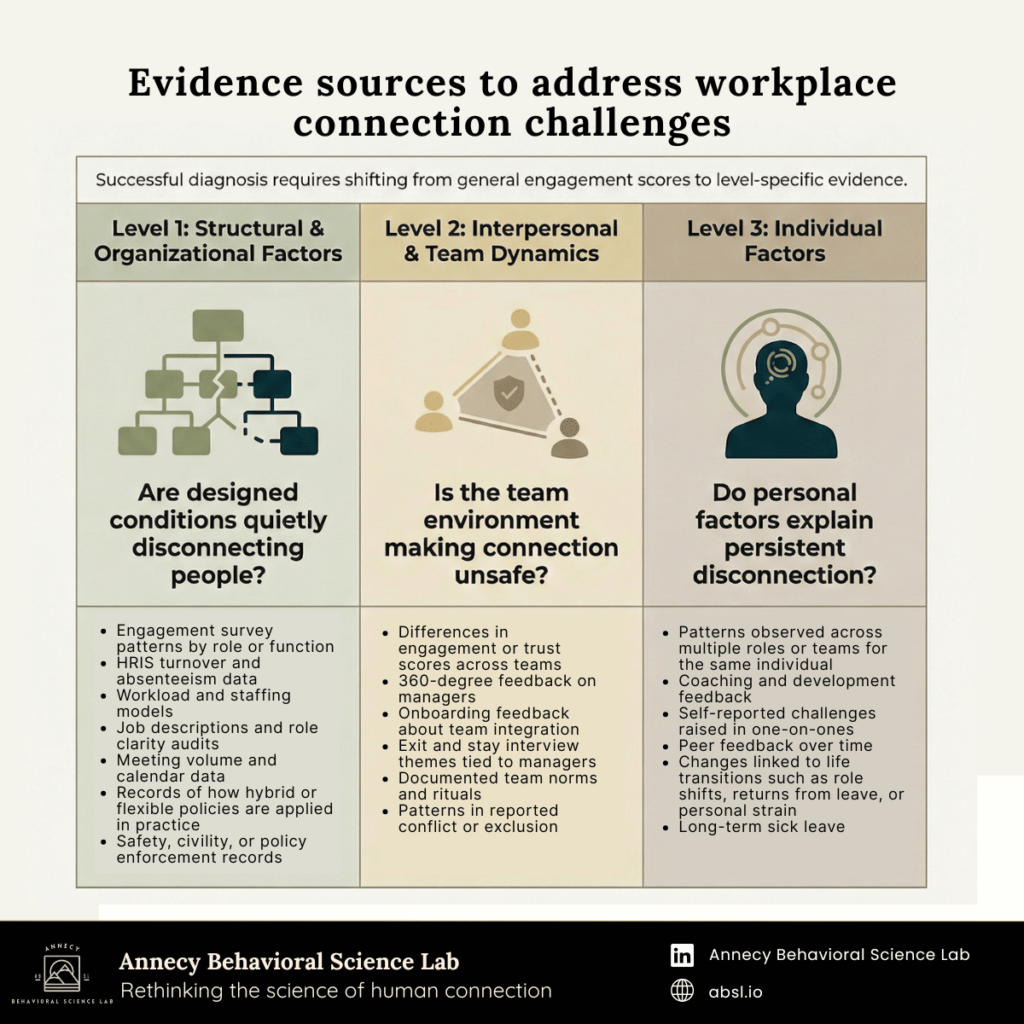
Key diagnostic question: Are the conditions we have designed quietly disconnecting people?
Structural factors set the context for everything that follows. When work design is misaligned, policies create friction, or role boundaries are unclear, even capable managers and motivated employees have limited room to act differently.
What to assess at the structural level
When similar patterns appear across multiple teams or roles, examine:
- Work design: workload distribution, staffing ratios, meeting volume, calendar density, scheduling patterns
- Policies: hybrid and remote implementation, decision authority, autonomy, performance and promotion criteria, flexible work access in practice
- Role clarity: job boundaries, accountability, cross-functional coordination requirements
- Organizational support: collaboration resources, technology infrastructure, budget for enablement
- Mode of contact: physical versus virtual mix, synchronous versus asynchronous defaults
- Restructuring and transitions: reorganizations, leadership changes, workforce reductions, integration strain
Where to look for evidence
When you see repeated strain in the same roles regardless of who holds them, gather evidence from these sources to confirm structural causes:
- Engagement survey patterns by role or function
- HRIS turnover and absenteeism data
- Workload and staffing models
- Job descriptions and role clarity audits
- Meeting volume and calendar data
- Records of how hybrid or flexible policies are applied in practice
- Safety, civility, or policy enforcement records
Aggregate data reveals structural patterns, but personalized assessment helps distinguish whether high workload reflects inadequate staffing ratios, unclear role boundaries, or individual circumstances requiring different interventions. If the same problems show up in the same roles with different people, the evidence confirms a structural root cause.
What structural-level misdiagnosis looks like in practice
Case 1: Downsizing without workload redesign
| Situation | Intervention Used | Reason for Mismatch | Suggested Solution |
| The organization downsized from 400-500 to about 300 employees. Miscommunication and unclear decision rights led to misaligned KPIs, client dissatisfaction, and in some cases, revenue loss. | Mental health leave credits and wellness lectures through their HMO provider. | The core issue was structural. Workload design, role expectations, and staffing ratios after downsizing stayed unresolved. When structural conditions push employees into survival mode, individual supports become temporary relief, not a fix. People can take leave, but if they return to the same impossible workload and unclear expectations, exhaustion and disconnection persist. | Address workload distribution, staffing ratios, role clarity, and organizational support first before implementing individual-level wellness programs. At the structural level, unsustainable conditions reduce time to connect and limit meaningful exchanges that build workplace connection. |
What if there are adequate resources given already, but there is still something not working?
Case 2: Adequate benefits, low utilization
| Situation | Intervention Used | Reason for Mismatch | Suggested Solution |
| During sustained global disruption, employees and people leaders reported heightened stress, emotional exhaustion, and reduced motivation. The organization offered comprehensive mental health benefits, yet utilization remained low. Deeper assessment revealed cultural stigma surrounding mental health, managers lacking confidence to hold supportive conversations, low trust in confidentiality of services, and workload constraints preventing access to support. | Leadership initially considered expanding benefit offerings further, assuming lack of awareness or insufficient resources were the primary issues. | Even when structural conditions are adequate, cultural stigma, manager capability gaps, and trust deficits prevent employees from accessing available support. Expanding benefits does not solve access problems. | Rather than expanding benefits, implement targeted interventions that address underlying conditions for access: educational campaigns to reduce stigma (burnout education, energy management skills), manager capability building (toolkits for supportive conversations, training to recognize warning signs), organizational enablers (clear resource signposting, sustainable work habits, norms protecting time for wellbeing activities); focus on barrier removal over benefit expansion. |
Structural evidence (like HRIS data, workload models, and cross-team patterns) reveals system-wide conditions. But when problems vary by team despite identical structure, the evidence points you toward team-level diagnosis.
Level 2: Interpersonal and Team Dynamics
Key diagnostic question: If the structure seems sound, is the team environment making connection unsafe?
Once structural conditions are addressed or ruled out, team dynamics become the next high-yield focus. Teams operating under the same organizational conditions often show very different levels of connection based on how managers lead and how norms develop.
What to assess at the team level
When outcomes vary significantly across teams operating under the same structure, examine:
- Leadership climate: manager accessibility, consistency of leadership practices, modeling vulnerability
- Psychological safety: comfort speaking up, response to mistakes, inclusivity in decisions
- Team norms: informal rituals, boundaries around work hours, participation expectations
- Collaboration quality: information sharing, peer support, cross-functional cooperation
- Communication practices: frequency, reciprocity, clarity of expectations, cross-cultural and cross-generational adaptations
- Conflict resolution: how disagreements are handled, mediation support, repair after tension
- Support provision: emotional, informational, instrumental, and recognition support
Where to look for evidence
When you see the same structural conditions producing different outcomes across teams, gather evidence from these sources to confirm team climate causes:
- Differences in engagement or trust scores across teams
- 360-degree feedback on managers
- Onboarding feedback about team integration
- Exit and stay interview themes tied to managers
- Documented team norms and rituals
- Patterns in reported conflict or exclusion
This is where personalized assessment becomes critical. Static surveys can’t distinguish whether low psychological safety reflects team climate issues or individual circumstances without adaptive questioning that explores what people mean when they say they don’t feel safe speaking up.
When teams under identical structure show different connection levels, the evidence confirms team-level root causes. When the pattern follows one person across roles or teams, move to individual-level evidence.
When outcomes vary by team despite identical structure, focus here. When the team signal is weak or the pattern follows one person across roles or teams, move to individual-level evidence.
What team-level misdiagnosis looks like in practice
| Situation | Intervention Used | Reason for Mismatch | Suggested Solution |
| Team members would proceed with tasks without fully understanding requirements and hesitate to ask for help, repeatedly leading to below-expectation deliverables. | Better documentation, revised project briefing templates, and new collaboration tools (treating it as a structural/process problem). | This pattern often signals a psychological safety gap. If the manager dismisses questions or shows impatience with clarification, employees will keep nodding in meetings and struggling alone, and quality problems will persist because the true constraint is team climate, not process design. | Identify teams where below-expectation work clusters alongside reluctance to ask for help, then provide targeted manager development in psychological safety practices and facilitate team norm-setting. At this level, the signal typically looks like low emotional safety, weak perceived responsiveness, and limited support provision. |
Team climate evidence (like manager 360s, engagement differences across teams, and exit interview themes) pinpoints leadership and norm issues. When one person struggles across multiple supportive teams, the evidence pattern changes. Individual-level diagnosis requires longitudinal, person-specific data.
Level 3: Individual Factors
Key diagnostic question: When structure and team dynamics are supportive, do individual factors explain persistent disconnection?
This is where many organizations start, but it should be the final stop in the diagnostic process. Individual interventions matter, but only after system and team causes have been ruled out. Otherwise, organizations risk pathologizing normal responses to unhealthy conditions.
What to assess at the individual level
When the pattern is person-specific and persists across roles or teams, examine:
- Personality traits: introversion or extroversion, emotional sensitivity, openness
- Beliefs: self-efficacy, assumptions about belonging, expectations of reciprocity
- Mental health: anxiety, depression, burnout, stress responses
- Personal life circumstances: caregiving, health challenges, relocation, financial strain
- Social skills: communication style, conflict navigation, relationship initiation and maintenance
- Coping strategies: support-seeking, use of professional resources, reliance on family or community
- Life transitions: role changes, return from leave, career shifts, family structure changes
- Neurodiversity and accessibility needs: cognitive, sensory, and communication differences that shape how individuals connect and participate
Where to look for evidence
When you see patterns that follow a specific person across different teams and roles, gather evidence from these sources to confirm individual-level causes:
- Patterns observed across multiple roles or teams for the same individual
- Coaching and development feedback
- Self-reported challenges raised in one-on-ones
- Peer feedback over time
- Changes linked to life transitions such as role shifts, returns from leave, or personal strain
- Long-term sick leave
At this level, personalized assessment becomes essential. Individual needs, values, and circumstances vary dramatically, and what “belonging” or “support” means differs by person, culture, and life stage. Longitudinal, adaptive questioning helps distinguish whether someone’s persistent disconnection reflects personality traits, mental health challenges, life circumstances, or skill gaps—each requiring different support.
When someone struggles consistently across supportive environments, individual factors require attention.
Only after ruling out structural and team causes. When someone struggles consistently across supportive environments, individual factors require attention.
What individual-level misdiagnosis looks like in practice
| Situation | Intervention Used | Reason for Mismatch | Suggested Solution |
| An organization schedules social hours and connection activities exclusively after work to build team cohesion. While many employees appreciate these events, they systematically exclude employees with caregiving responsibilities, health challenges, or major life transitions. For someone managing parenthood, a health challenge, or a major transition, these programs become sources of stress and exclusion rather than connection. The signal often shows up as reduced volition about relationships, lower felt authenticity, or a sense of obligation that creates resentment rather than connection. | The organization treats connection as a team-wide solution, implementing mandatory or expectation-heavy team-building activities, social events, and collaboration rituals scheduled at times that don’t accommodate individual circumstances. | Even well-intended connection programs create the opposite effect when the structure of participation ignores individual constraints. What works well for most employees can inadvertently isolate those facing different life circumstances. | Make participation voluntary and timing flexible—offer connection opportunities at varied times, ask employees for preferences about timing and format, rotate event types to accommodate different needs, and provide practical support where feasible so employees can join without pressure. Greater impact often comes from embedding connections into existing initiatives rather than creating standalone programs. For example, structured volunteering tied to causes employees care about can strengthen workplace relationships while respecting individual constraints through flexible participation formats. This prevents connection initiatives from becoming sources of obligation or exclusion. |
Design elements that increase impact while respecting individual circumstances:
• Team-based participation: Colleagues join as intact teams or cross-functional groups, strengthening interpersonal bonds while contributing to a shared cause
• Identity-aligned causes: Campaigns that support communities employees personally identify with can deepen belonging and purpose
• Flexible engagement options: Varied activities (fundraising, volunteer hours, movement challenges, mindfulness minutes) allow different forms of participation
• Collective goals: Shared milestones create achievement without requiring identical contributions from each person
• Wellbeing integration: Activities incorporate health and wellbeing components, linking social good with personal wellbeing.
For instance, teams might work toward a collective movement goal tied to a health equity cause, raise funds for community wellbeing organizations, or volunteer time supporting initiatives that advance inclusion. Participating as a group fosters camaraderie and shared pride, while flexible formats allow individuals to contribute in ways that fit their circumstances.
This approach respects individual constraints while still creating meaningful opportunities for connection. By embedding connection, inclusion, and wellbeing into already-established efforts, organizations amplify value without adding program complexity, transforming participation from symbolic engagement into meaningful, research-aligned employee experiences. At the individual level, this prevents connection initiatives from becoming sources of obligation or exclusion, instead allowing authentic participation that builds genuine workplace relationships.
Beyond the Organization: Community as a Connection Multiplier
Workplace connection doesn’t exist in isolation. Employees are embedded in neighborhoods and social networks that extend beyond office walls. Isolation tends to spread across relational contexts through threat-hypervigilance and self-protective behaviors that undermine connection. When work schedules or norms prevent employees from participating in community life, both workplace and community connections suffer. Conversely, organizations that support community engagement often see benefits in workplace cohesion and wellbeing.
Community connection operates differently than workplace interventions: it’s reciprocal (employees contribute to and draw from community resources), ecological (connection happens in neighborhoods, not just networks), enduring (community ties often outlast employment), and scalable (community infrastructure creates conditions individual employers can’t build alone).
Where to look for evidence of community disconnection
When workplace interventions plateau despite addressing structural, team, and individual factors, examine geographic isolation (low social infrastructure, car-dependent design), time poverty (work schedules blocking community participation), access barriers (childcare, transportation, financial constraints), cultural displacement (employees relocated without established ties), and neighborhood social capital (civic participation rates, trust norms).
Evidence sources include work-life balance surveys asking about community time, geographic data on where employees live and available infrastructure, participation patterns in location-based events, exit interviews mentioning community isolation, and requests for flexible time to accommodate community commitments.
Community-integrated interventions
Organizations facilitate community connection through partnerships and organizational enablers. Partnerships include supporting neighborhood connection platforms like République des Hypervoisins, participating in community gathering events like The Longest Table that bridge work and residential communities, and forming local civic partnerships around volunteer opportunities and community care networks.
Organizational enablers include time policies protecting community participation (predictable schedules, volunteer time off), geographic flexibility in hybrid work policy (allowing employees to live near family or community), benefits reducing time poverty (childcare support, transportation assistance), and relocation support including community integration resources.
Embedding community connection into existing corporate social responsibility platforms amplifies impact without adding complexity. Research demonstrates that prosocial behavior and volunteering link to higher life satisfaction, improved mental health, and stronger social connectedness. Design elements that work include team-based participation strengthening interpersonal bonds around shared causes, identity-aligned causes deepening belonging and purpose, flexible engagement options (fundraising, volunteer hours, movement challenges) allowing varied participation, collective goals creating achievement without requiring identical contributions, and wellbeing integration linking social good with personal health.
Teams might work toward collective movement goals tied to health equity causes, raise funds for community wellbeing organizations, or volunteer supporting inclusion initiatives. Participating as a group fosters camaraderie while flexible formats allow individuals to contribute in ways that fit their circumstances.
When community-level focus makes sense
Focus here when workplace interventions have addressed other levels but connection remains low, when geographic or life circumstances create isolation beyond workplace programs, when employees request more community or family time flexibility, when turnover suggests people leave for better work-life integration, or when your workforce includes many relocations, remote workers, or shift workers with limited workplace contact.
Conclusion
Workplace connection programs fail when interventions don’t match root causes, and mismatches happen when diagnosis relies on assumptions instead of evidence. Ask diagnostic questions at each level, examine the relevant dimensions, and gather evidence that confirms where disconnection originates.
Structural patterns appear in HRIS data and workload models. Team climate shows up in manager feedback and engagement differences. Individual factors emerge through longitudinal, person-specific observations. When you strengthen your diagnosis with holistic, level-appropriate evidence, you avoid wasting resources on mismatched interventions and build solutions that actually address the root cause.
Gather the right evidence first. Then you’ll know where the problem lives and what intervention will work.