

Key points
- Effective employee strategy starts with diagnosing whether disconnection is driven by structural constraints, team dynamics, or individual factors, since this determines where intervention will have the highest leverage.
- Connection initiatives produce uneven results when they address symptoms without first identifying the underlying source of disconnection.
- Getting the diagnostic sequence right helps organizations focus on fewer, higher-impact interventions and build more scalable, sustainable solutions over time.
Most organizations invest in connection initiatives with good intent. They roll out empathy training, wellness programs, team rituals, or mentoring schemes. Sometimes these efforts move engagement metrics. Sometimes they do not. Often, results vary widely across teams operating under similar organizational conditions.
These outcomes are not always signs of poor execution or lack of commitment. More often, they reflect a deeper issue: the intervention was aimed at the wrong problem.
Effective employee strategy starts with diagnosing whether disconnection stems from structural constraints, team dynamics, or individual factors. That diagnosis determines where interventions will have the highest leverage. Without a diagnosis, organizations risk treating symptoms rather than causes and mistaking activity for progress.
This post introduces a diagnostic framework designed to help CHROs identify where disconnection is actually generated before launching the next initiative. The goal is not to do more, but to intervene more precisely and more effectively.
Why Diagnosis Matters: The Cost of Getting It Wrong
Diagnosis shapes everything that follows. When the source of disconnection is misidentified, even well-intentioned efforts can reinforce the conditions that undermine connection.
Gartner’s insights from 426 CHROs across 23 industries point to a shift in HR leadership. As organizations move toward 2026, leaders are moving to learning system literacy, not just empathy. Two imperatives stand out. First, leaders must build systems that change routine. Organizations are three times more likely to achieve healthy adoption when change is embedded into daily work. Second, leaders must counter culture atrophy by weaving desired behaviors into the rhythms of work through policies, workflows, and decisions, rather than relying on campaigns.
This system’s focus highlights a common failure mode. Connection efforts lose traction when they are designed before leaders are clear on what is disrupting connection in the first place. Without diagnosis, initiatives are applied broadly regardless of whether disconnection is driven by structural constraints, team dynamics, or individual factors. Activity increases, but daily experience remains unchanged.
Skipping diagnosis creates predictable tradeoffs. Resources are invested in solutions that do not address the underlying issue. Employees are asked to engage with initiatives that leave core frustrations untouched. Over time, responsibility tends to shift toward individuals, as people are encouraged to adapt to conditions that are better addressed at the system or team level.
This is not a failure of intent or effort. It is a challenge of problem selection. This is why diagnosis must come before design.
Why One-Size-Fits-All Connection Strategies Fall Short
Across organizations, similar symptoms of disconnection show up in different ways depending on culture, priorities, resources, and leadership context. Some workplaces struggle with burnout across entire functions. Others see sharp differences between teams operating under the same policies. In still other cases, disconnection is concentrated in specific individuals despite otherwise supportive environments.
These patterns point to a practical conclusion: connection breaks down at different levels in different workplaces, and intervention effectiveness depends on matching the solution to the actual source of the problem.
Our ABSL ROI Calculator reflects this principle quantitatively. When organizations input their disconnection symptoms and match interventions to the correct diagnostic level, modeled returns are substantially higher than generic approaches. Tailored interventions that address root causes can yield two to three times the impact of mismatched solutions that treat symptoms while leaving underlying conditions unchanged.
But how do CHROs conduct this root-cause analysis in practice? The framework below provides a structured approach.
A Three-Level Diagnostic Framework
The framework presented here draws from Burke and Litwin’s 1992 causal model of organizational performance and change, which distinguishes three levels where outcomes are shaped: organizational design through structure and systems, work climate through the team and leadership environment, and individual factors through needs, skills, and motivation.
For practical application to social connection initiatives, we consolidate these into a streamlined three-level approach informed by three inputs:
- Recent workplace loneliness research, which surfaces connection drivers across organizational, team, and individual levels
- Our research on developing a global monitoring framework for social connection developed across eight countries, which identifies core dimensions of connection as people experience them across life, not just at work. This creates a more holistic workplace framework that sees employees as whole people.
- Qualitative interviews with people leaders across industries about their connection pain points and past interventions, which ground the framework in concrete organizational realities
Strategically, this means a systematic connection strategy should begin with a diagnostic scan across the organizational design, work climate, and individual factors, rather than defaulting to programs for individual-level solutions. To apply this framework effectively, CHROs need to understand which connection dimensions each level affects.
How the Framework Maps to Connection Dimensions
This diagnostic structure maps to distinct dimensions of workplace connection:
- Structural factors shape whether interaction can occur—frequency, mode of contact, and relationship access
- Team factors shape how safe and supportive those interactions feel—trust, responsiveness, and conflict resolution
- Individual factors shape subjective experience—authenticity, belonging, volition, and appreciation
By diagnosing at the correct level, organizations can target the connection dimensions most likely to shift and avoid spreading effort across interventions that do not match the problem.
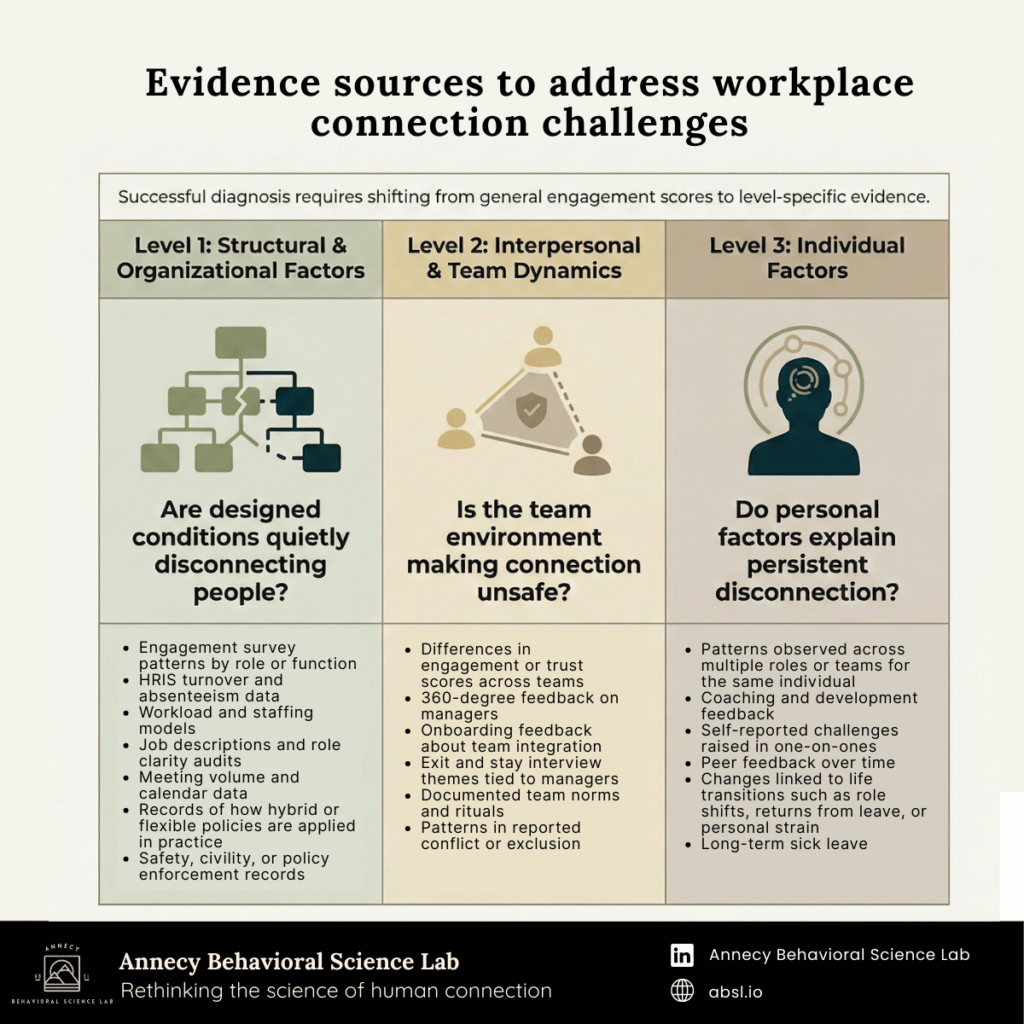
Here’s what each level encompasses:
The Three Diagnostic Levels
Level | Factors | Key diagnostic question | What to Assess | Example Interventions |
| Structural and Organizational | Work design such as workload distribution, staffing ratios, and meeting loads. Policies such as hybrid and remote implementation, decision authority, and performance systems. Role clarity, organizational support, mode of contact, and restructuring transitions. | Are the conditions we have designed quietly disconnecting people? | Job demands-resources balance (workload, time pressure, role ambiguity vs. autonomy, support), perceived organizational support, work-life integration, access to resources | Workload rebalancing, hybrid policy redesign, role clarity frameworks, organizational norm-setting for boundaries and protected time, decision authority redistribution |
| Interpersonal and Team Dynamics | Leadership climate, psychological safety, team norms, collaboration quality, and communication practices including frequency, reciprocity, and cross-cultural or cross-generational dynamics. Conflict resolution and support provision including emotional, informational, instrumental, and recognition. | If the structure seems sound, is the team environment making connections unsafe? | Psychological safety (Edmondson), team climate quality, manager support effectiveness, trust and confidentiality, communication reciprocity | Manager toolkits for supportive conversations, psychological safety building, conflict resolution protocols, team norm co-creation, peer support structures |
| Individual Factors | Personality traits, beliefs, mental health, personal life circumstances such as caregiving, health challenges, relocation, social skills, coping strategies, and life transitions. | When structure and team dynamics are supportive, do individual factors explain persistent disconnection? | Sense of belonging, personal wellbeing indicators, coping capacity, cultural readiness, skill gaps, life transition impacts | Mental health education and destigmatization, skill-building on energy management and recovery, EAP access support, life transition resources, belonging initiatives |
Note: These interventions are illustrative examples, not prescriptive solutions. Effective interventions must be tailored to specific organizational contexts, cultural readiness, and diagnostic findings. What works in one organization or team may not translate to another. The value of diagnosis is identifying which level to address and which connection dimensions to target—the specific intervention design should follow from that analysis. Similarly, measurement approaches should be selected based on organizational culture, data maturity, and the specific connection dimensions being diagnosed.
These levels are interconnected rather than isolated. For practical root-cause analysis, it is useful to distinguish between them because structural conditions set the boundaries within which teams and individuals operate day to day. Each level shapes what is realistically possible at the next. This is why the order matters.
A Final Note on Root-Cause Leadership
A culture of connection cannot be built through programs alone. It must be engineered into systems, relationships, and daily work.
For CHROs, this means shifting from activity management to root-cause leadership. It means diagnosing before designing, addressing structural constraints even when they are uncomfortable, and recognizing that what works in one part of the organization may not work in another.
The future-ready HR leader does not just measure engagement. They diagnose disconnection at the right level, sequence interventions strategically, and build connections into the architecture of work itself. This approach allows organizations to solve fewer but higher-yield problems more systematically over time.
In our next post, we will explore how to match specific interventions to each diagnostic level, including evidence-based measurement approaches and practical implementation strategies. We’ll examine how to sequence interventions, when to combine levels, and how to avoid the most common design mistakes that undermine connection initiatives even when diagnosis is correct.g activity for progress.
This post introduces a diagnostic framework designed to help CHROs identify where disconnection is actually generated before launching the next initiative. The goal is not to do more, but to intervene more precisely and more effectively.
Why Diagnosis Matters: The Cost of Getting It Wrong
Diagnosis shapes everything that follows. When the source of disconnection is misidentified, even well-intentioned efforts can reinforce the conditions that undermine connection.
Gartner’s insights from 426 CHROs across 23 industries point to a shift in HR leadership. As organizations move toward 2026, leaders are moving to learning system literacy, not just empathy. Two imperatives stand out. First, leaders must build systems that change routine. Organizations are three times more likely to achieve healthy adoption when change is embedded into daily work. Second, leaders must counter culture atrophy by weaving desired behaviors into the rhythms of work through policies, workflows, and decisions, rather than relying on campaigns.
This system’s focus highlights a common failure mode. Connection efforts lose traction when they are designed before leaders are clear on what is disrupting connection in the first place. Without diagnosis, initiatives are applied broadly regardless of whether disconnection is driven by structural constraints, team dynamics, or individual factors. Activity increases, but daily experience remains unchanged.
Skipping diagnosis creates predictable tradeoffs. Resources are invested in solutions that do not address the underlying issue. Employees are asked to engage with initiatives that leave core frustrations untouched. Over time, responsibility tends to shift toward individuals, as people are encouraged to adapt to conditions that are better addressed at the system or team level.
This is not a failure of intent or effort. It is a challenge of problem selection. This is why diagnosis must come before design.
Why One-Size-Fits-All Connection Strategies Fall Short
Across organizations, similar symptoms of disconnection show up in different ways depending on culture, priorities, resources, and leadership context. Some workplaces struggle with burnout across entire functions. Others see sharp differences between teams operating under the same policies. In still other cases, disconnection is concentrated in specific individuals despite otherwise supportive environments.
These patterns point to a practical conclusion: connection breaks down at different levels in different workplaces, and intervention effectiveness depends on matching the solution to the actual source of the problem.
Our ABSL ROI Calculator reflects this principle quantitatively. When organizations input their disconnection symptoms and match interventions to the correct diagnostic level, modeled returns are substantially higher than generic approaches. Tailored interventions that address root causes can yield two to three times the impact of mismatched solutions that treat symptoms while leaving underlying conditions unchanged.
But how do CHROs conduct this root-cause analysis in practice? The framework below provides a structured approach.
A Three-Level Diagnostic Framework
The framework presented here draws from Burke and Litwin’s 1992 causal model of organizational performance and change, which distinguishes three levels where outcomes are shaped: organizational design through structure and systems, work climate through the team and leadership environment, and individual factors through needs, skills, and motivation.
For practical application to social connection initiatives, we consolidate these into a streamlined three-level approach informed by three inputs:
- Recent workplace loneliness research, which surfaces connection drivers across organizational, team, and individual levels
- Our research on developing a global monitoring framework for social connection developed across eight countries, which identifies core dimensions of connection as people experience them across life, not just at work. This creates a more holistic workplace framework that sees employees as whole people.
- Qualitative interviews with people leaders across industries about their connection pain points and past interventions, which ground the framework in concrete organizational realities
Strategically, this means a systematic connection strategy should begin with a diagnostic scan across the organizational design, work climate, and individual factors, rather than defaulting to programs for individual-level solutions. To apply this framework effectively, CHROs need to understand which connection dimensions each level affects.
How the Framework Maps to Connection Dimensions
This diagnostic structure maps to distinct dimensions of workplace connection:
- Structural factors shape whether interaction can occur—frequency, mode of contact, and relationship access
- Team factors shape how safe and supportive those interactions feel—trust, responsiveness, and conflict resolution
- Individual factors shape subjective experience—authenticity, belonging, volition, and appreciation
By diagnosing at the correct level, organizations can target the connection dimensions most likely to shift and avoid spreading effort across interventions that do not match the problem.
Here’s what each level encompasses:
The Three Diagnostic Levels
Level | Factors | Key diagnostic question |
| Structural and Organizational | Work design such as workload distribution, staffing ratios, and meeting loads. Policies such as hybrid and remote implementation, decision authority, and performance systems. Role clarity, organizational support, mode of contact, and restructuring transitions. | Are the conditions we have designed quietly disconnecting people? |
| Interpersonal and Team Dynamics | Leadership climate, psychological safety, team norms, collaboration quality, and communication practices including frequency, reciprocity, and cross-cultural or cross-generational dynamics. Conflict resolution and support provision including emotional, informational, instrumental, and recognition. | If the structure seems sound, is the team environment making connections unsafe? |
| Individual Factors | Personality traits, beliefs, mental health, personal life circumstances such as caregiving, health challenges, relocation, social skills, coping strategies, and life transitions. | When structure and team dynamics are supportive, do individual factors explain persistent disconnection? |
These levels are interconnected rather than isolated. For practical root-cause analysis, it is useful to distinguish between them because structural conditions set the boundaries within which teams and individuals operate day to day. Each level shapes what is realistically possible at the next. This is why the order matters.
A Final Note on Root-Cause Leadership
A culture of connection cannot be built through programs alone. It must be engineered into systems, relationships, and daily work.
For CHROs, this means shifting from activity management to root-cause leadership. It means diagnosing before designing, addressing structural constraints even when they are uncomfortable, and recognizing that what works in one part of the organization may not work in another.
The future-ready HR leader does not just measure engagement. They diagnose disconnection at the right level, sequence interventions strategically, and build connections into the architecture of work itself. This approach allows organizations to solve fewer but higher-yield problems more systematically over time.


Pingback: Evidence-Based Diagnosis for CHROs: Matching Workplace Connection Interventions to Root Causes - ABSL